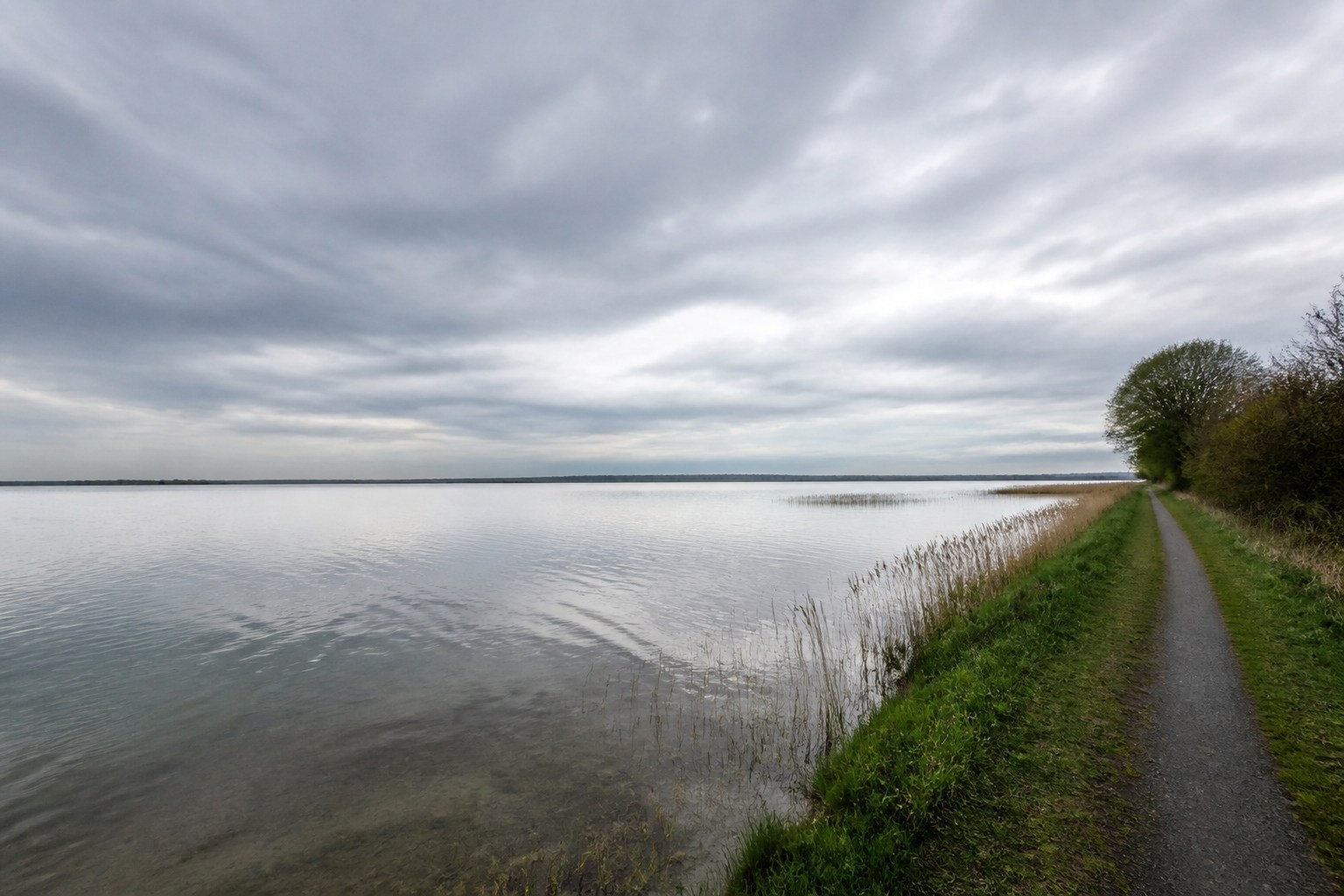
Why the lake feels larger than its map
Steinhuder Meer covers about twenty-nine square kilometres, which is modest beside Alpine reservoirs and yet generous in northwest Germany. The trick is the horizon. There is almost no far shore that rises. Clouds slide across the water as if the lake were a second sky. On a west-wind day the surface turns hammered silver; on a still morning it holds the reed line like a ruler.
Steinhude, on the east, is the practical landing. Brick, boats, a promenade that knows how to be busy in July without pretending to be a coast. From here the dike path begins its long, almost level circuit. You do not need a mountain bike. You need a jacket. The wind on the dam crown is the only real climb, and it changes the temperature faster than any forecast app.
Mardorf, on the south-west, is the other character. Sand, a slightly raised hinterland, a different plant mix, and a view that looks back across the full plate of water. Between the two, nature-park rules keep parts of the reed as working habitat rather than a lawn. That is why a lake day is also a distance day: you stay on the path, and the birds stay in the shallows. The wildlife calendar is written for that etiquette.
Wilhelmstein, the small island fortress, is a historical punctuation mark, not the reason to come. The reason is the loop: water on one shoulder, meadow and wood on the other, a sequence of small bathing places and observation gaps. Ride it clockwise if you want the afternoon light on the water toward Mardorf; ride it the other way if you prefer to finish in Steinhude with a bakery still open.
How to use the lake inside a longer journey
As day one of the five-day itinerary, Steinhuder Meer teaches the grammar you will reuse at Dümmer and on the Weser: stay on the engineered line, watch the weather, do not chase the shoreline through protected reed. As a single outing from Hanover it is enough. As a cycling classroom it pairs with the dike routes and with the oak woods of Rehburg-Loccum, which sit close enough to be a wind-break afternoon after a hard lake morning.
Winter is not closed. The water goes graphite, the beaches empty, and the sky becomes the whole subject. You will want the same dike, a hat, and no ambition to complete the loop for sport. The lake is still doing its work: holding space.