Observation · distance first
Birds as weather, not as trophies
Greylag geese, cranes, herons, kingfishers: the wetland cast of Lower Saxony. The method is stillness on the dike, never a walk into the nest line.
Four named seasons
Water May
Fresh meadows, high water, loud greens. Best for first-time walkers on Steinhuder Meer and the Weser floodplains. Breeding signs appear; some reed paths close. Watch at dawn if you want geese leaving the water, not a crowd.
Silver July
Long days, bicycles, calmer lakes at evening. Birding is quieter; heat haze sits on Dümmer. Good for the Lake Loop. Herons still fish the ditches. Kingfishers are a luck event on the Weser, never a guarantee.
Bronze September
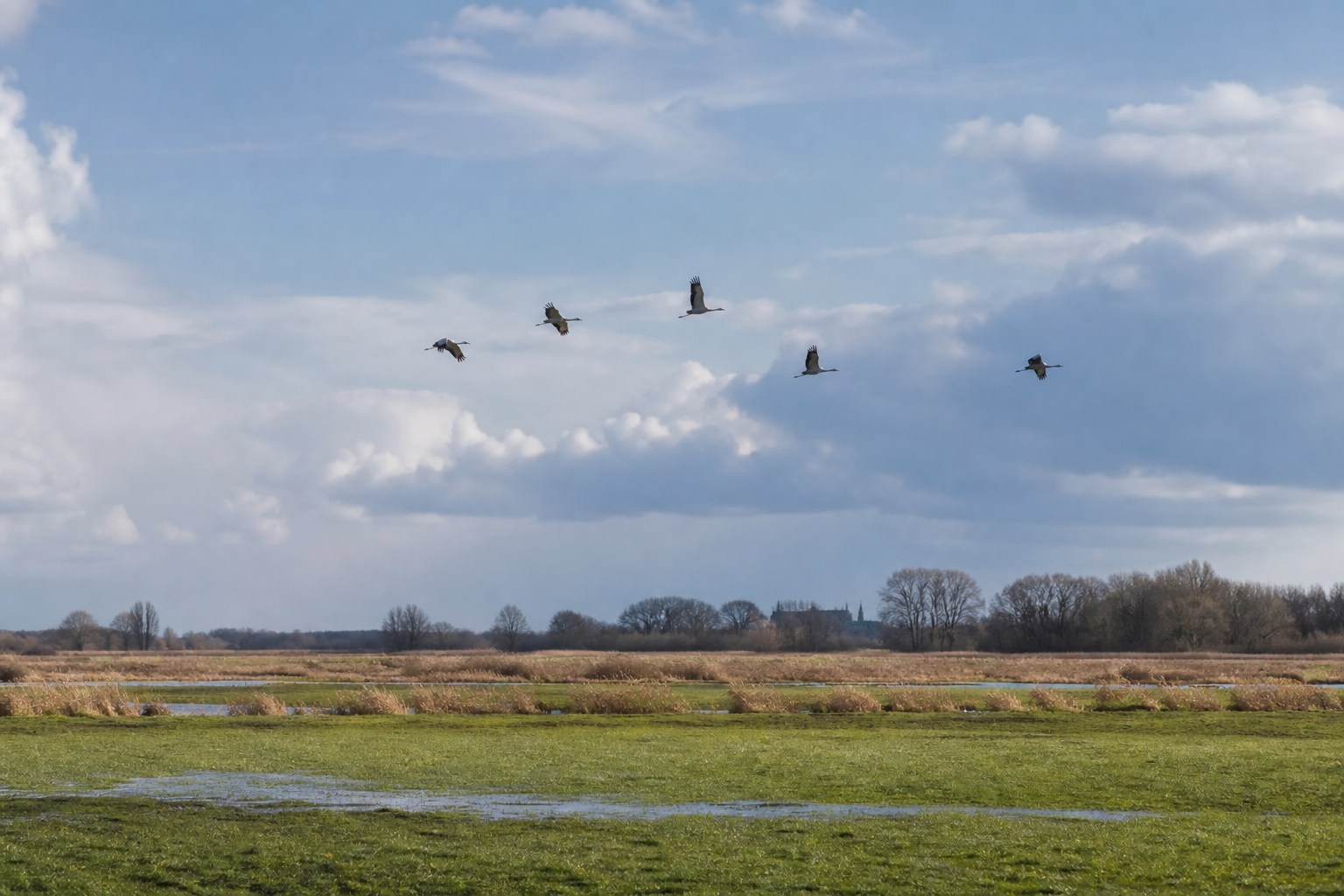
Reed goes gold, mornings cool, migration begins to write the sky. This is the month for Dümmer See. Cranes over meadows are the image people keep. Stay on the dam. The flock is the subject; you are not.
Cloud December
Silver sky, empty shores, graphic land. Geese still use the basins. Woods at Rehburg go black against the fields. Short days: one water, one wood, then the train.
Questions people actually ask
Do I need a hide?
Useful at Dümmer, optional on the Steinhuder dike. A hide is a room, not a right to closer birds. If it is full, wait. The glossary explains what the German signs mean by observation point.
When is too close?
If the bird changes behaviour because of you, you have already failed the day. Telephoto from the path. No drones over reed. Dogs on leads where posted — which is most of the water.
Can I combine this with the five-day route?
Yes. Put bird ambition on day 5, swimming ambition on day 1–2, and accept that July and November are different countries. See the itinerary.
What should I actually carry?
Windbreaker, rain shell, shoes that accept wet grass, water, binoculars, sun protection, offline map. The same list serves the dike rides. A long lens is optional; behaviour is not.
Greylag geese use the basins almost the year round and are the ordinary soundtrack of a dike. Common cranes write the more famous autumn sentence, especially around Dümmer and wet meadows after harvest. Grey herons work the ditches of the Weser as if they were furniture. Kingfishers are a brief electric line under a bridge or a cut bank — you do not plan a day around them. Watch from the path. The spectacle is often four hundred metres away, which is the correct distance for a living wetland.
Dawn is better than noon for geese leaving water. Late afternoon is better for bronze reed and returning flocks. Midday in July is for cycling, not for hides. If you only remember one rule: the wetland is already using the space you want to stand in. Your job is to borrow a sliver of dike and give it back without a photograph that required a flushed bird.
The calendar is a map
Once you know the month, the lake, the river and the wood fall into a useful order.
Open the five-day line